Nestled in the heart of south-central England, the Cotswolds represents the quintessence of the British countryside. Famous for its honey-colored limestone villages, rolling hills, and historic manor houses, this Area of Outstanding Natural Beauty (AONB) is a paradise for outdoor enthusiasts. While walking trails often steal the spotlight, exploring on two wheels offers a unique vantage point. Cycling routes in the Cotswolds provide the perfect blend of physical challenge and aesthetic reward, allowing visitors to cover more ground while remaining immersed in the landscape.
Whether you are a competitive road cyclist seeking grueling ascents or a family looking for a leisurely Sunday ride, the region offers a diverse array of paths. In this guide, we break down the best cycling routes, logistical tips, and scenic highlights for every skill level.
Why Cycle the Cotswolds?
The geography of the Cotswolds is defined by a limestone escarpment, resulting in a landscape of wolds (rolling hills) and winding river valleys. This topography creates a dynamic riding experience. According to the Cotswolds National Landscape, the area covers nearly 800 square miles across five counties, offering endless variety.
Cycling here is not just about the exercise; it is a journey through history. You will pedal past Neolithic barrows, Roman settlements, and medieval wool churches. Furthermore, the region has embraced cyclist culture, with numerous cafes and inns catering specifically to riders.
Preparing for Your Ride: Logistics and Safety
Before embarking on your journey, it is crucial to prepare for the specific conditions of the English countryside.
Choosing the Right Bike
- Road Bikes: Ideal for the smooth tarmac of the country lanes and the steep climbs of the escarpment.
- Gravel/Hybrid Bikes: Perfect for those who want to mix road riding with bridleways and fire roads.
- E-Bikes: An increasingly popular choice that flattens the hills, making the cycling routes Cotswolds has to offer accessible to all fitness levels.
Safety and Etiquette
The country lanes can be narrow, often bordered by high hedges or stone walls. Always adhere to the British Cycling Highway Code regarding road positioning and visibility. Additionally, rural areas are agricultural hubs; be prepared to slow down for tractors, horses, and livestock.
Getting There
The Cotswolds is well-connected by rail. You can transport bikes on trains operated by Great Western Railway (GWR), which services key gateways like Moreton-in-Marsh, Kingham, and Kemble. However, remember to book a bike slot in advance, especially during peak seasons.
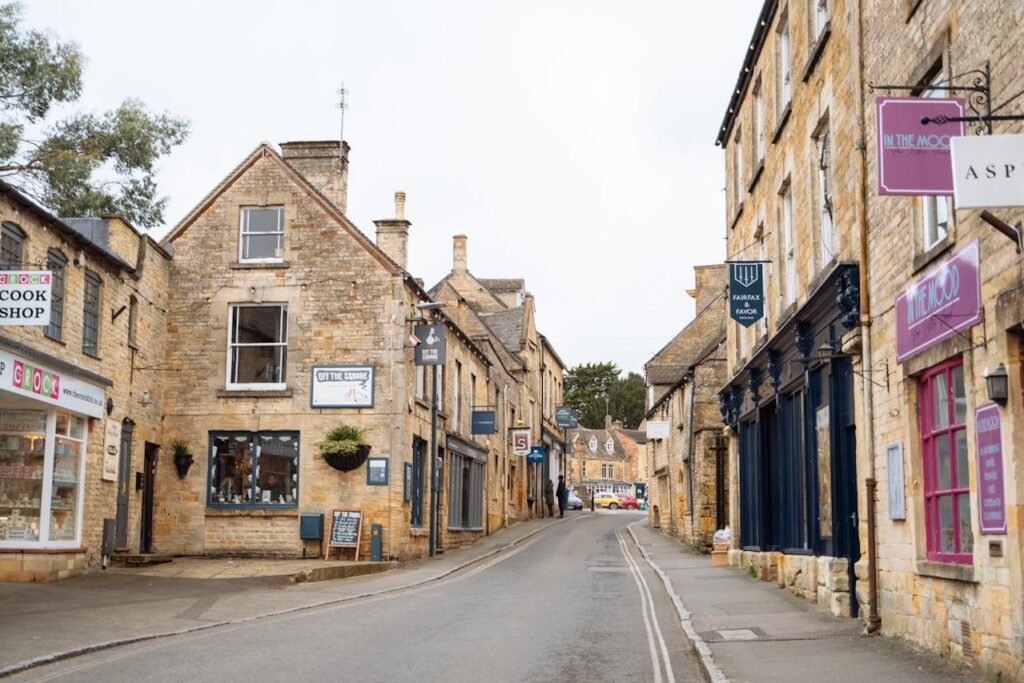
The Leisure Rider: Flat Valleys and Historic Villages
Target Audience: Families, casual riders, and history buffs.
For those who prefer scenery over sweat, the river valleys offer gentle terrain. These routes focus on the “chocolate box” villages and allow plenty of time for tea and cake.
The Windrush Valley Wander
Starting in the iconic village of Bourton-on-the-Water, often called the “Venice of the Cotswolds,” this route stays relatively flat by following the River Windrush. You can cycle towards Lower Slaughter and Upper Slaughter, two of the most preserved villages in England. The roads here are quiet, and the distances are short (5-10 miles loop).
- Highlight: The Old Mill at Lower Slaughter.
- Terrain: Paved village roads and hard-packed bridleways.
The Flatlands of Fairford
Located in the southern Cotswolds, the area around Fairford and Lechlade-on-Thames is significantly flatter. This area connects with the wider National Cycle Network, specifically Route 45. A ride here offers wide-open skies and easy pedaling along the Thames.
The Intermediate Cyclist: Undulating Hills and Endurance
Target Audience: Fitness enthusiasts and club riders.
Intermediate riders will want to experience the “wolds”—the rolling hills that give the region its name. These routes involve some climbing but reward effort with sweeping vistas.
The Cotswold Line Cycle Route
This linear route roughly follows the railway line from Oxford to Worcester, but doing a segment from Moreton-in-Marsh to Chipping Campden is a fantastic day ride. It involves manageable elevations and passes through quintessential market towns. Visit Visit Moreton-in-Marsh for local amenities before you start.
The Bibury Loop
Starting in Cirencester, the “Capital of the Cotswolds,” this route heads east toward Bibury. You will encounter the famous Arlington Row, a set of 14th-century weavers’ cottages owned by the National Trust. The ride back involves some steady climbing but nothing too technical. The loop is approximately 20-25 miles.
The Expert: The Escarpment and Steep Ascents
Target Audience: Serious roadies, climbers, and endurance athletes.
The western edge of the Cotswolds features a steep escarpment that drops down to the Severn Vale. This geological feature provides some of the most challenging climbs in the UK, often featured in the Tour of Britain.
Dover’s Hill and The Snowshill Loop
Starting near Broadway, this route tackles Dover’s Hill, the site of the historic Olympick Games. It is a punchy climb with gradients reaching over 10%. From there, the route descends and climbs again into Snowshill, a secluded village famous for its lavender fields and the eccentric Snowshill Manor. Check weather conditions via the Met Office before attempting these descents, as wet limestone can be slippery.
The 100-Mile Cotswold Sportive Challenge
For those looking to test their mettle, linking the northern and southern Cotswolds into a “century ride” is the ultimate challenge. A popular trajectory is a loop starting in Cheltenham, hitting Cleeve Hill (the highest point in the Cotswolds), and sweeping south through Painswick and Stroud. Riders utilize apps like Strava or Komoot to navigate the complex web of backroads.
Route Comparison Data
To help you select the best itinerary for your skill level, we have compiled a comparison of popular segments within the region.
| Route Name | Difficulty | Approx. Distance | Elevation Gain | Key Feature | Best Bike Type |
|---|---|---|---|---|---|
| The Slaughters Loop | Beginner | 6 miles (10km) | 250 ft | River Windrush & Historic Mills | Hybrid / City |
| Cirencester to Bibury | Intermediate | 22 miles (35km) | 1,100 ft | Arlington Row & Roman History | Road / Gravel |
| The Burford Circular | Intermediate | 30 miles (48km) | 1,600 ft | Medieval Bridge & High Street | Road |
| Broadway & Snowshill | Advanced | 35 miles (56km) | 2,800 ft | Steep Escarpment Climbs | Lightweight Road |
| The Five Valleys | Expert | 50 miles (80km) | 4,500 ft | Stroud Valleys & Tech Descents | Performance Road |
Seasons and Weather
The Cotswolds is a year-round destination, but the experience varies wildly by season.
- Spring (March-May): Arguably the best time. The lambs are in the fields, the rapeseed crops turn the hills yellow, and the temperature is mild.
- Summer (June-August): The warmest weather, but also the busiest traffic on narrow roads. Early morning rides are recommended.
- Autumn (September-November): The beech woods turn a spectacular copper color. The Forestry England sites, such as Westonbirt Arboretum, are particularly stunning nearby, though cycling inside the Arboretum itself is restricted to specific family trails.
- Winter (December-February): Only for the hardy. Frost can linger on shaded lanes all day.
Historical Stops and Cultural Context
No guide to cycling routes Cotswolds is complete without mentioning the heritage. When routing your trip, consider stopping at English Heritage sites like Hailes Abbey near Winchcombe. These ruins provide a tranquil spot to rest and refill water bottles.
Furthermore, the region’s prosperity was built on the wool trade. The “Wool Churches” at Northleach and Cirencester are architectural marvels paid for by wealthy medieval merchants. They dominate the skyline and serve as excellent navigation waypoints.
Conclusion
From the gentle, stream-side paths of the Windrush Valley to the lung-busting ascents of Dover’s Hill, the Cotswolds offers a cycling experience that rivals any in Europe. It is a landscape that demands to be savored slowly, where every turn in the road reveals a new panoramic view or a centuries-old stone cottage.
Whether you bring your own carbon-fiber road bike or rent an e-bike upon arrival, the most important step is simply to start pedaling. Plan your route, check your gear, and immerse yourself in one of England’s most cherished landscapes.
Ready to ride? Start mapping your journey today using the Ordnance Survey maps for the most detailed view of the bridleways and byways, and discover the Cotswolds the way it was meant to be seen.