For decades, Kyoto has held the crown as the custodian of Japanese history. Its vermilion torii gates, bamboo groves, and geisha districts are the images that fuel wanderlust globally. However, the surge in global tourism has transformed the ancient capital into a bustling hub that can sometimes feel more crowded than contemplative. For travelers seeking the serenity and authenticity of the Edo period without the overwhelming crowds, the journey north to the Ishikawa Prefecture offers a compelling alternative. This is the allure of Kanazawa traditional Japan—a city often dubbed “Little Kyoto,” yet possessing a distinct, artistic soul entirely its own.
Why Kanazawa is the New Frontier for Culture Seekers
While Kyoto was the seat of the Imperial Court, Kanazawa was the seat of the Maeda Clan, the second most powerful feudal domain after the Tokugawa Shogunate. This wealth allowed the city to cultivate a level of high culture, craftsmanship, and gastronomy that rivals Tokyo and Kyoto.
Unlike many Japanese cities that were modernized or destroyed during World War II, Kanazawa was spared from air raids. Consequently, its historical districts remain remarkably intact. As the Japan National Tourism Organization notes, the city preserves an architectural heritage that offers a seamless window into the past. Here, the experience of traditional Japan is not a reenactment; it is a living, breathing reality found in the narrow lanes of the samurai districts and the steaming kitchens of its markets.
Getting There: The Journey North
The perception of Kanazawa being “remote” vanished with the extension of the bullet train lines. Accessing the region is seamless via the Hokuriku Shinkansen, which connects Tokyo to Kanazawa in just about 2.5 hours. For those already in the Kansai region (Kyoto or Osaka), the Thunderbird Limited Express creates a scenic bridge between the two cultural capitals.
For international travelers, utilizing the Hokuriku Arch Pass—a regional variation of the famous Japan Rail Pass—allows for an economical loop trip from Tokyo to Kyoto via Kanazawa, encouraging exploration of this “Golden Route.”
The Jewel of Ishikawa: Kenrokuen Garden
No discussion of Kanazawa traditional Japan is valid without beginning at Kenrokuen. Ranked as one of the Three Great Gardens of Japan, Kenrokuen is a masterclass in landscape theory. The name translates to “Garden of the Six Sublimities,” referring to the six essential attributes of a perfect garden: spaciousness, seclusion, artifice, antiquity, water courses, and panoramas.
Originally the private outer garden of Kanazawa Castle, Kenrokuen features the oldest fountain in Japan, operating purely on natural water pressure. In winter, the garden takes on a surreal beauty due to yukitsuri—conical rope structures attached to pine trees to prevent branches from snapping under the weight of heavy, wet snow typical of the Hokuriku region. Visiting the Kenrokuen Garden official site before your trip can help you check the schedule for special light-up events, which transform the landscape into a nocturnal fantasy.
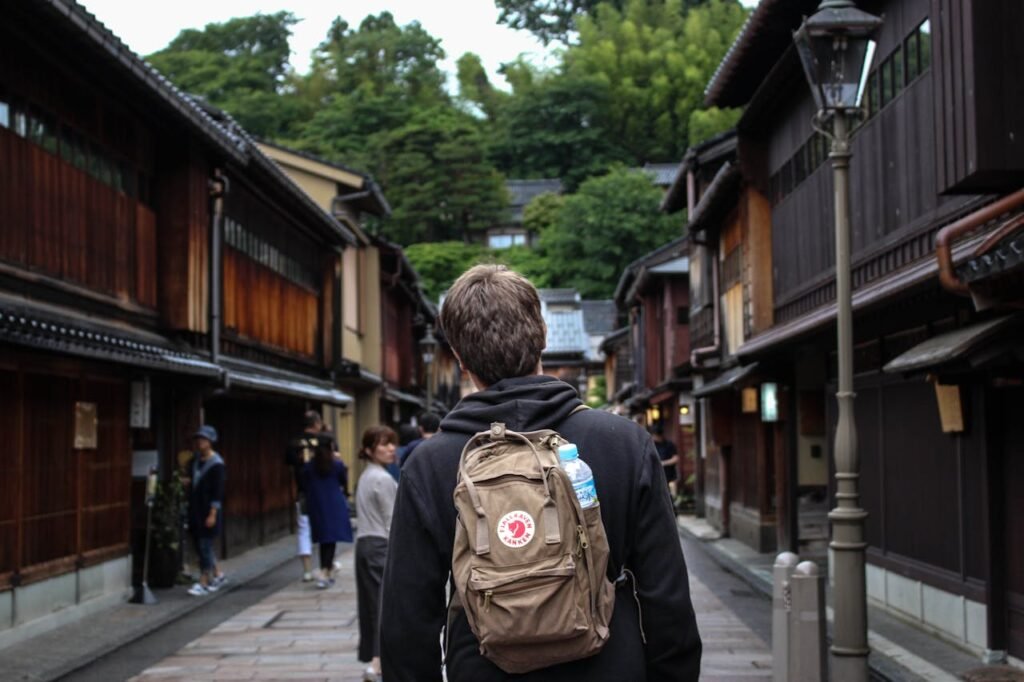
Samurai and Geisha Districts: Stepping Back in Time
Kanazawa’s urban planning is a testament to its feudal past, separated distinctly into areas for the samurai class and areas for entertainment.
Nagamachi Samurai District
A short walk from the city center lies Nagamachi, where the winding streets are lined with earthen walls made of mud and straw, shielding the former residences of the samurai. The highlight here is the Nomura Clan Samurai House. Unlike many museums that feel sterile, this restored residence features a stunning inner garden with a meandering stream and heirlooms that display the martial and artistic sophistication of the samurai class.
Higashi Chaya District
On the other side of the Asano River lies the Higashi Chaya District. Chaya (tea houses) were exclusive venues where geisha entertained wealthy patrons with song and dance. Today, this district remains one of the few places outside Kyoto where geisha culture survives authentically. The wooden lattice facades are beautifully preserved, and several houses, such as Shima and Kaikaro, open their doors to the public.
This area is also the heart of Kanazawa’s gold leaf production. The city produces 99% of Japan’s gold leaf, a craft recognized by the UNESCO Creative Cities Network. Visitors can experience this luxury firsthand, from applying gold leaf to lacquerware to consuming soft-serve ice cream wrapped in a sheet of edible gold.
Culinary Delights: From Omicho Market to Kaga Cuisine
While Kyoto is famous for kaiseki (imperial court cuisine), Kanazawa prides itself on Kaga-ryori, a cuisine influenced by the abundance of the Sea of Japan. The epicenter of this food culture is Omicho Market, often called “Kanazawa’s Kitchen.”
Established in the Edo period, this covered market is a sensory overload of fresh seafood. In winter, the prize catch is the Snow Crab (Kano-gani) and the female Kobako crab, delicacies that draw gourmands from across the country. Deep within the market, small restaurants serve kaisendon—bowls of rice topped with overflowing sashimi—at a fraction of the price one might pay in Tokyo.
Art and Architecture: A Blend of Old and New
One of the most striking aspects of Kanazawa is how it balances its feudal history with aggressive modernity. It does not rely solely on the past.
The 21st Century Museum of Contemporary Art, designed by SANAA architects, is a circular, glass-walled marvel that challenges the definition of a museum. Its most famous installation, Leandro Erlich’s “The Swimming Pool,” allows visitors to stand beneath a layer of water, looking up at the sky—a playful inversion of perspective.
Conversely, the D.T. Suzuki Museum, dedicated to the world-renowned Zen philosopher, utilizes minimalist architecture to encourage contemplation. It is a quiet counterpoint to the busy tourist hubs, offering a “Water Mirror Garden” that embodies the Zen spirit of nothingness.
Kyoto vs. Kanazawa: A Traveler’s Comparison
To help you decide how to allocate your time in Japan, here is a comparison of these two cultural titans.
| Feature | Kyoto | Kanazawa |
|---|---|---|
| Primary Vibe | Imperial Grandeur, Bustling, Iconic | Samurai Heritage, Artistic, Intimate |
| Crowd Level | Very High (Overtourism creates bottlenecks) | Moderate (Busy on weekends, quiet weekdays) |
| Top Garden | Kinkaku-ji / Ryoan-ji | Kenrokuen (Spacious, walkable) |
| Food Focus | Kaiseki & Tofu (Vegetarian friendly) | Fresh Seafood (Sushi/Sashimi) & Kaga Cuisine |
| Accessibility | Direct Shinkansen from Tokyo | Shinkansen (2.5 hrs) or Express from Kyoto |
| Best for… | First-time visitors checking off bucket lists | Repeat visitors or those seeking slower travel |
Day Trips: Shirakawa-go and Noto
Kanazawa serves as the perfect base camp for exploring the Japanese Alps. A popular day trip is to the historic villages of Shirakawa-go, a UNESCO World Heritage Site famous for its traditional gassho-zukuri farmhouses. These structures, with their steep thatched roofs designed to withstand heavy snow, offer a glimpse into rural Japanese life that is starkly different from the samurai elegance of Kanazawa.
Additionally, the Noto Peninsula to the north offers rugged coastlines and agricultural heritage, identified as a Globally Important Agricultural Heritage System (GIAHS). While the region is recovering from seismic activity, checking the Ishikawa Prefecture Official Site provides the latest updates on accessible areas and how tourism can support recovery.
Conclusion: The Quiet Confidence of Kanazawa
Choosing to visit Kanazawa is not about skipping Kyoto; it is about broadening the definition of what a Japanese cultural experience can be. Where Kyoto dazzles with the magnitude of its history, Kanazawa charms with its accessibility and depth.
From the gold-flecked crafts to the mist rolling off the Kenrokuen ponds, Kanazawa traditional Japan offers a slower, more tactile engagement with history. As travelers increasingly look for sustainable ways to explore the world, diverting from the Golden Route to spend a few days in Ishikawa is not just a detour—it is a destination in its own right.
If you are ready to trade the packed buses of Gion for the quiet, rain-slicked cobblestones of Nagamachi, Kanazawa is waiting to welcome you with a bowl of matcha and a story centuries in the making.